
Earth and life · 4.54 billion years
The Entire History of Earth
If the whole history of the Earth fitted into a single day, the dinosaurs would arrive at 10:47 pm, the asteroid would strike at 11:39 pm, and we would appear with less than six seconds to go before midnight.
The player picks the audio language from your YouTube settings. You can change it in the settings wheel, under “Audio track”.
What it covers
The documentary turns the planet's 4.54 billion years into a single day. At midnight the Earth is born from the disc of dust around the Sun; soon after, a collision with another forming planet creates the Moon.
From there it travels through the first ocean, the first signs of life, the oxygen made by cyanobacteria that poisoned the planet, the ice ages that covered it in ice, the Cambrian explosion, the Great Dying of the Permian, the reign of the dinosaurs and the Chicxulub asteroid.
The final minutes belong to the mammals, and to a species that arrived with less than six seconds to go before midnight: ours.
Chapters and timeline
Select a chapter to jump to that moment in the documentary.
Sources
The specific facts in the documentary (dates, sites, figures) come from these sources.
- Age of the Earth, 4.54 ± 0.05 billion years: USGS, “Age of the Earth” · pubs.usgs.gov/gip/geotime/age.html
- The giant-impact origin of the Moon: NASA, “Where did our Moon come from?” · nasa.gov/?p=284335
- Jack Hills zircons, 4.374 billion years: Valley et al. 2014, Nature Geoscience · doi:10.1038/ngeo2075
- The Miller experiment: Miller 1953, Science · doi:10.1126/science.117.3046.528
- Amino acids in the Murchison meteorite: Kvenvolden et al. 1970, Nature · doi:10.1038/228923a0
- The Great Oxidation Event: review in PMC (NCBI) · ncbi.nlm.nih.gov/pmc/articles/PMC8238953
- Day length 1.4 billion years ago: Meyers & Malinverno 2018, PNAS · doi:10.1073/pnas.1717689115
- Bangiomorpha, 1.047 billion years: Gibson et al. 2018, Geology · doi:10.1130/G39829.1
- Dickinsonia was an animal: Bobrovskiy et al. 2018, Science · doi:10.1126/science.aat7228
- The iridium layer and the asteroid: Alvarez et al. 1980, Science · doi:10.1126/science.208.4448.1095
- The Chicxulub crater: Encyclopaedia Britannica; NASA NTRS 19970030228
- Homo sapiens at Jebel Irhoud, about 300,000 years: Hublin et al. 2017, Nature · doi:10.1038/nature22336
- The White Sands footprints: Bennett et al. 2021, Science · doi:10.1126/science.abg7586
About the images
The images are AI-generated recreations: they illustrate what the science says and are not real photographs. Researched and reviewed script; produced with the help of AI tools.
Continue the journey
See all documentaries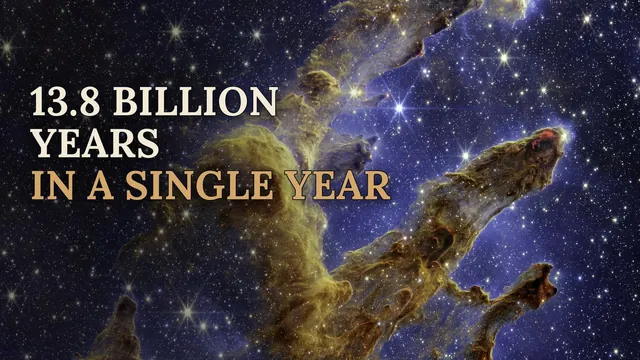
The Entire History of the Universe
If the whole history of the universe fitted into a single year, the Big Bang would happen on 1 January and all of recorded human history would fit into the last 11 seconds of 31 December.
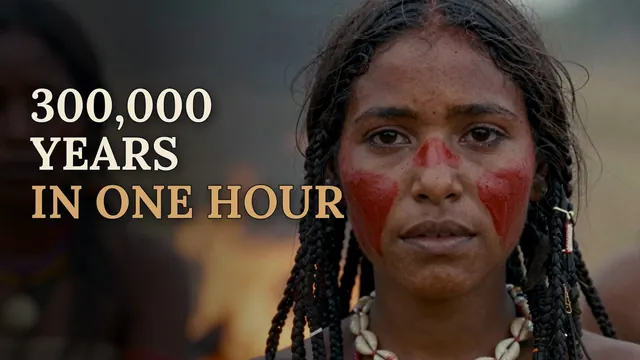
The Entire History of Humanity
If the whole history of our species fitted into a single day, farming would arrive after eleven at night, and the pyramids, Rome, the printing press and the Moon landings would all fit into the last 22 minutes.