
Humanity · 300,000 years
The Entire History of Humanity
If the whole history of our species fitted into a single day, farming would arrive after eleven at night, and the pyramids, Rome, the printing press and the Moon landings would all fit into the last 22 minutes.
The player picks the audio language from your YouTube settings. You can change it in the settings wheel, under “Audio track”.
What it covers
The documentary travels through 300,000 years of Homo sapiens as if they were a single day. It begins with the fossils of Jebel Irhoud, in Morocco, and with the first signs of an imagining mind: pigments, pierced shells, ornaments.
It continues with the great departure from Africa, the meeting with Neanderthals and Denisovans, cave art and life in the last Ice Age. Then come farming, the first cities, writing and the empires, the great ideas, a connected world and the acceleration of the last two centuries.
It is a story with gaps, and the documentary says where they are.
Chapters and timeline
Select a chapter to jump to that moment in the documentary.
Sources
The specific facts in the documentary (dates, sites, figures) come from these sources.
- Jebel Irhoud, the oldest Homo sapiens: Hublin et al. 2017, Nature · doi:10.1038/nature22336; Richter et al. 2017, Nature · doi:10.1038/nature22335
- Earliest modern humans outside Africa (Misliya): Hershkovitz et al. 2018, Science · doi:10.1126/science.aap8369
- Bizmoune shell beads: Sehasseh et al. 2021, Science Advances · doi:10.1126/sciadv.abi8620
- The Blombos drawing: Henshilwood et al. 2018, Nature · doi:10.1038/s41586-018-0514-3
- The Neanderthal genome: Green et al. 2010, Science · doi:10.1126/science.1188021
- Timing of Neanderthal admixture: Sümer et al. 2024, Nature · doi:10.1038/s41586-024-08420-x
- Ust-Ishim: Fu et al. 2014, Nature · doi:10.1038/nature13810
- Grotte Mandrin: Slimak et al. 2022, Science Advances · doi:10.1126/sciadv.abj9496
- The disappearance of the Neanderthals: Higham et al. 2014, Nature · doi:10.1038/nature13621
- Narrative cave art in Sulawesi: Oktaviana et al. 2024, Nature · doi:10.1038/s41586-024-07541-7
- The White Sands footprints: Bennett et al. 2021, Science · doi:10.1126/science.abg7586
- The Stonehenge Altar Stone: Clarke et al. 2024, Nature · doi:10.1038/s41586-024-07652-1
- World population: United Nations, World Population Prospects 2024 · population.un.org/wpp
- Life expectancy and extreme poverty: Our World in Data · ourworldindata.org; World Bank · pip.worldbank.org
- The Atlantic slave trade: Trans-Atlantic Slave Trade Database · slavevoyages.org
- Carbon dioxide in the air: NOAA Global Monitoring Laboratory · gml.noaa.gov/ccgg/trends
About the images
The images are of two kinds: real photographs of archaeological sites, museum objects and historical archives, and AI-generated recreations that illustrate what archaeology and history tell us. Researched and reviewed script; produced with the help of AI tools.
Continue the journey
See all documentaries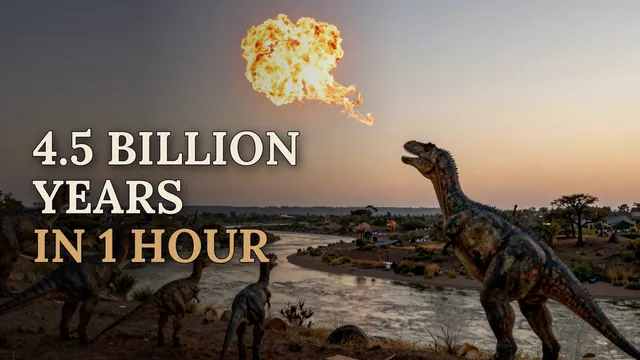
The Entire History of Earth
If the whole history of the Earth fitted into a single day, the dinosaurs would arrive at 10:47 pm, the asteroid would strike at 11:39 pm, and we would appear with less than six seconds to go before midnight.
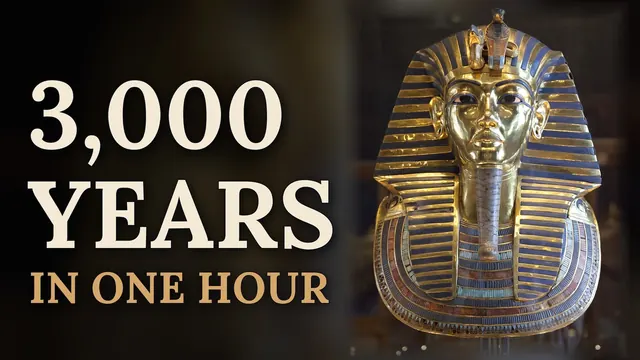
The Entire History of Ancient Egypt
If the whole history of ancient Egypt were a river 3,000 kilometres long, with each kilometre one year, the Great Pyramid would stand at kilometre 540 and Cleopatra just before the sea. Cleopatra lived closer in time to us than to the workers who built the Great Pyramid.